

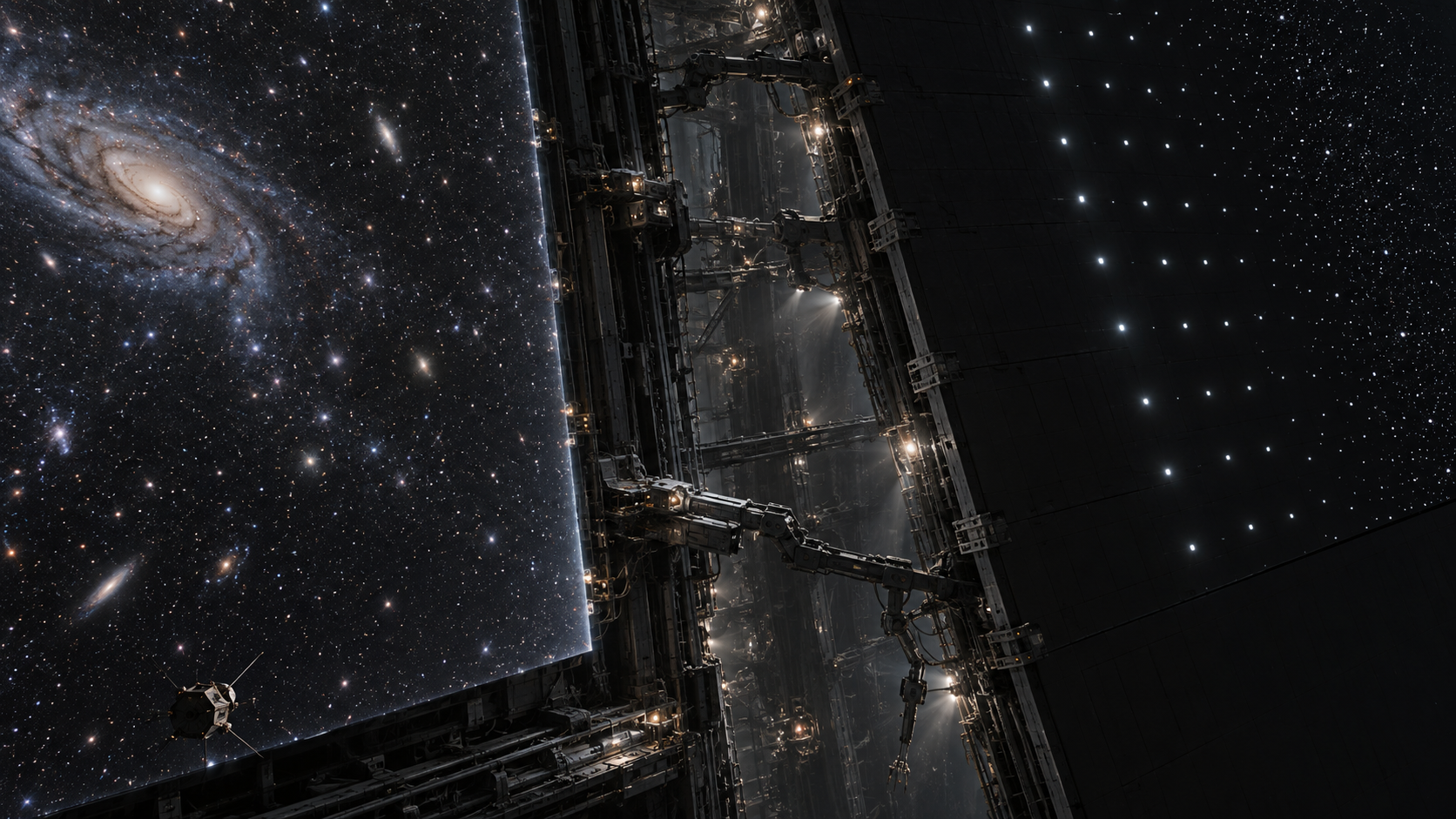
The Last Photograph
The first probe to leave their system sent one final image home.
After generations of work, a civilization sends its first probe beyond the influence of its star. Its final transmission shows something that should not exist.
# The Last Photograph
The last photograph arrived eight minutes before the probe disappeared.
At first, nobody understood what they were looking at.
The image was badly distorted.
Half of it was black.
The other half contained a blurred field of pale geometric shapes, lines and shadows that had no reasonable place in interstellar space.
There were straight edges.
Parallel structures.
Something resembling scaffolding.
Something else that might have been machinery.
And in the lower corner of the image, almost lost beneath transmission noise, a surface.
A surface where there should have been nothing at all.
---
The probe had been called *Far Lantern*.
It was not especially large.
By the standards of the vessels that moved between the homeworld, its moon and the settlements beneath the domes of the next planet outward, it was barely a ship at all.
It had no crew.
No return stage.
No landing equipment.
It had been designed with a singular purpose.
Leave.
That purpose had required surprisingly much explanation.
Their civilization had sent machines almost everywhere worth sending machines.
Probes orbited every planet in the system.
They had landed on moons, flown through atmospheres, descended beneath clouds, drilled into ice and followed comets around the star.
Many remained where they had been sent for decades after their primary missions ended.
That was what probes were for.
You sent one somewhere because there was something there to study.
Sending one deliberately toward nothing had always seemed less useful.
Beyond the outer worlds there was only the dark between stars.
Nothing to orbit.
Nothing to land on.
Nothing waiting to be sampled.
Astronomers could already study the universe from home.
Their telescopes had measured neighboring stars, mapped galaxies and recorded explosions so distant that the light reaching them had begun its journey before their species had built its first cities.
They had catalogued planets around other suns.
They had measured the spectra of atmospheres they would never visit.
They knew their star was one among billions.
They knew their galaxy was one among billions more.
They knew the universe continued far beyond anything they could hope to reach.
But knowing was not the same as going.
Eventually that argument won.
*Far Lantern* was built partly as science, partly as engineering and partly because enough people decided that, after learning how to cross their own system, they should finally throw something beyond it simply to see what happened.
It had passed the outer planets.
Then the dwarf worlds.
Then the last regularly visited bodies whose years were measured in centuries.
Its signal weakened.
Its engines continued.
Every few months it transmitted another image backward.
The star diminished behind it.
The homeworld became impossible to resolve.
For the first time, something made by living hands was travelling deliberately toward the dark beyond the system.
There were celebrations on the homeworld.
The lunar colony projected the probe's departure telemetry across the wall of its largest public concourse.
On the neighboring planet, crews living beneath pressure domes delayed a scheduled tunnel blast so everyone could watch the final acceleration burn together.
Then the excitement faded.
That was expected.
Space was large.
For years, *Far Lantern* became little more than a faint repeating signal carried home through darkness.
Then its navigation system began reporting something impossible.
---
The first anomaly was dismissed as calibration drift.
There appeared to be matter ahead.
Not much.
Not enough to concern anyone.
A diffuse return from active ranging equipment.
The probe recalibrated itself.
The return remained.
It was assumed to be dust.
The density increased.
Then decreased.
Then increased again.
The shape of the return made no sense.
It was too broad.
Too flat.
And it remained almost perfectly perpendicular to the probe's course.
The mission team altered the ranging frequency.
The return changed.
But it did not disappear.
*Far Lantern* continued forward.
There was no reason not to.
Its cameras showed nothing.
The sky remained full of stars.
The active sensors insisted that something lay ahead.
The optical systems insisted that nothing did.
For months the disagreement continued.
The mission team joked about it.
Someone printed a shirt that read:
**THE VOID IS SOLID.**
It became popular at universities.
Then the range dropped quickly enough that the jokes stopped.
The return did not resolve into an asteroid.
It did not spread into a cloud.
It remained flat.
Broad.
Ahead.
The cameras continued showing stars.
Then *Far Lantern* transmitted the photograph.
---
Director Halen Vorr stared at it for nearly a minute before speaking.
"Send the previous frame."
The previous photograph appeared beside it.
Stars.
Nothing else.
"Next."
The final photograph returned.
Blackness.
Geometry.
A pale surface.
"Time difference?"
"Fourteen seconds."
"Fourteen?"
"Yes."
Vorr moved closer to the display.
"Where are the stars?"
No one answered.
The mission room was ordinarily noisy.
Researchers spoke across one another.
Someone was always eating.
Someone was always complaining about a sensor.
Someone was always asleep somewhere they technically should not have been asleep.
Now nobody moved.
Vorr enlarged the photograph.
Transmission damage became blocks.
Lines.
Missing colour.
The geometry remained.
"Could this be inside the probe?"
"No."
"Reflection?"
"No."
"Image corruption?"
"Not like this."
Vorr looked toward the navigation specialists.
"Distance to the anomaly?"
One of them swallowed.
"At the probe's last reported velocity..."
He stopped.
"What?"
"Eight minutes."
Vorr looked again at the photograph.
The probe had transmitted for eight more minutes after taking it.
Then nothing.
---
For the next six days, every antenna capable of reaching the probe transmitted continuously.
Commands.
Reset sequences.
Emergency wake instructions.
Navigation overrides.
Requests for telemetry.
Requests for anything.
Nothing returned.
*Far Lantern* had gone silent.
The official announcement described a probable collision with uncharted debris.
Almost nobody who had seen the final photograph believed that explanation was sufficient.
Then the image escaped.
There was no agreement afterward about who released it.
One observatory blamed a research partner.
The research partner blamed an automated archive.
A government ministry denied possessing the image several hours after one of its own representatives had already discussed it publicly.
Another government published a higher-quality copy the following morning and stated, with some satisfaction, that its citizens were capable of deciding for themselves whether a photograph looked unusual.
By the end of the week, none of that mattered.
Copies were everywhere.
Most people looked at it once.
Some looked at it for days.
Scientists argued over transmission corruption.
Engineers argued over camera failure.
Journalists found retired members of the probe program willing to say that none of the explanations made sense.
Thousands of people enhanced the image.
Most of the enhancements were useless.
Several invented details that had never existed.
One particularly popular version contained what appeared to be a doorway.
It was almost certainly compression noise.
This did not prevent several million people from discussing the doorway.
Daily life continued.
People went to work.
Freight crossed between the homeworld and its moon.
Supply launches departed for the neighboring colony.
Markets opened.
Schools taught classes.
Restaurants served dinner beneath screens showing the same damaged photograph everyone had already seen.
Some people were frightened.
Some were excited.
A few behaved as if the end of civilization had been announced.
Most had no useful way to distinguish an unprecedented scientific discovery from a very strange equipment failure billions of kilometres away.
Astronomers did.
---
The largest optical observatories turned toward the final coordinates of *Far Lantern*.
So did smaller ones.
Then private observatories.
Then amateurs with instruments that had cost more than some houses.
At first they found nothing.
The coordinates contained stars.
Galaxies.
Ordinary darkness.
Then someone published a stacked exposure collected across eleven nights.
There was a spot.
Barely.
A region fractionally darker than the surrounding field.
Another observatory reproduced it.
Then another.
A wealthy amateur on the night side of the homeworld published his own data with the raw exposures attached.
His telescope could not resolve anything within the anomaly.
It could barely prove that the anomaly existed.
That was enough.
The spot sat almost exactly along the final trajectory of *Far Lantern*.
It did not behave like a star.
It did not behave like a planet.
And, once enough observations accumulated, it did something even worse.
It moved.
Not on its own.
The displacement followed the homeworld's orbit around the star.
The spot traced the same repeating path against the distant sky year after year.
It was parallax.
Nothing about the object itself appeared to travel.
They were the ones moving.
The first published distance estimate was dismissed.
The second differed by less than one percent.
The third used observatories on the moon and the neighboring planet as additional baselines.
The answer remained the same.
Approximately forty astronomical units from their star.
The room where Vorr heard the result stayed silent for a long time.
The nearest star was not forty astronomical units away.
Nothing beyond their known system was supposed to be forty astronomical units away.
Certainly nothing large enough to leave a measurable dark mark against the universe.
The public debate changed.
It was no longer primarily about whether the final photograph had been corrupted.
Something was there.
The question became what.
---
They pointed everything at it.
Optical telescopes.
Radio arrays.
Infrared observatories.
Gravitational instruments.
Planetary radar systems never designed to operate across such distances.
Military tracking stations.
Weather satellites modified so aggressively that their manufacturers publicly denied responsibility.
The largest optical telescope ever constructed by their civilization turned its entire segmented mirror toward a patch of sky that, until *Far Lantern*, had contained nothing of special interest.
Nothing provided an answer everyone could accept.
But the answers became worse.
Radio pulses returned.
Weakly.
Not from the stars.
From approximately the same distance indicated by parallax.
The first result was rejected.
The second was classified.
The third was transmitted to several universities before the classification order reached them.
A private lunar observatory reproduced enough of it that classification became an argument about paperwork rather than secrecy.
There was something physically present near the edge of their system.
The dark spot was not floating freely.
Its position remained fixed relative to the star with a precision that made natural orbital explanations increasingly difficult.
There were tiny deviations.
Small periodic motions.
Wiggles.
Enough to occupy theorists for years.
Not enough to resemble an orbit.
Whatever the spot belonged to, it appeared to share the star's frame of reference.
That sentence generated more arguments than the photograph had.
---
The Planetary Defense Council had existed for eighty-three years.
Until that week, its largest disagreement concerned whether an asteroid interception system required a crew.
Now its meetings lasted sixteen hours at a time.
"We don't know that it's hostile."
"We don't know that it's natural."
"Natural things do not have straight lines."
"Crystals do."
"Crystals do not remain fixed forty astronomical units from a star."
"We have not established that it surrounds anything."
"Then what did the probe hit?"
"We do not know that the probe hit it."
"It transmitted a photograph of it eight minutes before contact ceased."
"Correlation."
"With what?"
Silence.
The council appropriated every deep-space propulsion program it could legally reach and several it probably could not.
Weapons projects became engine projects.
Engine projects became sensor projects.
Sensor projects became weapons projects again when someone asked what should happen if the next probe found something waiting.
Research institutions objected to military control.
The military objected to researchers publishing everything.
Private observatories published enough that both sides eventually had to accept that no one institution was going to own the discovery.
For the first time in generations, every major government agreed on the same priority.
Go back.
---
The second probe was built in nineteen months.
It was called *Lantern Two*, because committees should never be allowed to name historic spacecraft.
It was faster than the first.
It carried better cameras.
It carried active radar powerful enough to map an asteroid from across a planetary system.
It carried an engine capable of reversing thrust.
That last improvement received surprisingly little attention.
*Lantern Two* accelerated for years.
Then began transmitting the same strange ranging returns.
The surface ahead remained invisible.
Mission control ordered deceleration.
The engine burned.
The probe slowed.
The returns strengthened.
The mission team began celebrating.
For the first time they would approach the anomaly slowly enough to study it.
Six hours later the probe stopped transmitting.
No photograph survived.
---
The third probe carried three independent propulsion systems.
It lasted longer.
Its final telemetry suggested that deceleration had worked.
Then the ranging system reported an impossible increase in distance.
Then an impossible decrease.
Then nothing.
Three days afterward another tiny dark point appeared in the astronomical image.
Not adjacent to the first.
Far enough away that there was no plausible way the same local damage could explain both.
The public noticed before the government announced it.
The phrase **SECOND MARK** became the most widely repeated caption attached to astronomical images that year.
The implication was difficult to avoid.
The probes were not merely failing near the anomaly.
At least some of them were hitting it.
---
The fourth probe died at approximately the expected distance.
No new mark appeared.
The fifth did the same.
The sixth transmitted for eleven seconds longer than predicted.
No mark.
The seventh returned a radar profile.
The data made no sense.
The surface appeared smooth at one scale.
At another it contained ridges.
At another, repeating geometric features.
At another, structures hundreds of kilometres across.
The signal ended before the imaging systems could focus.
No new dark point appeared.
By then the civilization had changed.
Not collapsed.
Not transformed overnight.
Changed.
Children grew up knowing there was something at the edge of their system.
Universities created entire departments devoted to it.
Artists painted it.
Engineers designed around it.
Military planners developed strategies for defending planets against an enemy nobody had seen and that might not exist.
Amateur astronomers tracked the marks with equipment that became cheaper and better with every generation.
Most people still went to work.
The moon still required shipments.
The neighboring colony still expanded its buried settlements.
People argued about the boundary over dinner and then complained about weather, taxes and transit delays.
But every new deep-space engine was evaluated partly by how quickly it could reach forty astronomical units and, more importantly, how violently it could slow down when it arrived.
They became very good at slowing down.
---
The original mark changed slowly.
That took much longer to establish than its existence.
Its centre remained fixed.
Its shape did not.
Over the years, one edge became fractionally darker.
Then another.
The difference was small enough to disappear into calibration error.
Then too large.
The best professional observatories confirmed it first.
Private observatories followed.
The dark region was spreading.
Very slowly.
There were theories.
Residual heat from impact.
Cascading electrical failure.
Material fracture.
Some process no one had vocabulary for.
Whatever *Far Lantern* had done, it had not finished happening when the probe disappeared.
The defect was getting worse.
Then, for several years, it appeared to stabilize.
Then it began changing again.
By the time the eighth probe was ready, the original mark was visibly different from the first reliable astronomical measurements.
Still tiny.
Still difficult to resolve.
Still there.
Waiting.
---
The eighth probe was designed around every lesson the previous seven had purchased.
It was slower where it mattered.
More patient.
More redundant.
Its propulsion system could accelerate it across the emptiness and then spend years undoing what the first half of the journey had done.
It carried optical systems several generations beyond those aboard *Far Lantern*.
Radar.
Lidar.
Spectrometers.
Magnetometers.
Particle detectors.
Gravitational instruments whose designers had objected loudly when someone suggested placing them on a probe expected to crash.
It carried enough independent communications systems that losing all of them would require either extraordinary bad luck or an event nobody wished to define in advance.
Most importantly, it began braking long before anyone thought braking should be necessary.
The decision made the journey longer.
Nobody complained.
As the probe approached the forty-AU boundary, the ranging instruments stopped changing faster than the computers could interpret them.
The surface ahead resolved.
Mission control became quiet.
"Distance?" Vorr asked.
"Four thousand kilometres."
"Velocity?"
"Falling."
"Relative?"
"Almost nothing."
Vorr nodded.
"Good."
The first optical image arrived.
Black.
Not because the camera had failed.
Because whatever lay ahead absorbed nearly everything that struck it.
The probe increased exposure.
A texture appeared.
Then geometry.
Huge straight lines crossing one another.
Dark rectangles.
Raised structures.
Channels.
Something resembling equipment.
Something resembling scaffolding.
Exactly like the last photograph from *Far Lantern*.
Only now it was sharp.
And still.
Nobody cheered.
The first probe had crossed this distance.
For eight minutes.
"Three thousand kilometres."
The probe continued braking.
Two thousand.
One thousand.
Five hundred.
Vorr found himself gripping the edge of the console.
"Hold velocity."
"Holding."
"Do not get closer."
For the first time, something made by their civilization floated in darkness before the thing at the edge of their world and did not immediately die.
---
The damaged region was easy to find from five hundred kilometres away.
It was not easy to understand.
The probe mapped a blackened area several thousand kilometres across.
Long scars extended from one portion of it.
Some structures had collapsed.
Others were merely dark.
The impact point itself was difficult to identify with certainty.
There was too much damage.
"Is that *Far Lantern*?" someone asked.
No one answered.
The probe moved laterally.
Stopped.
Mapped.
Moved again.
For six days it followed the surface.
The wound did not end at a seam.
That discovery mattered.
The first seam lay thousands of kilometres beyond it.
The probe followed that seam.
It continued.
And continued.
Then turned.
Another seam crossed it.
Only after several long traverses did the geometry become obvious.
The damaged area was not itself a panel.
It was a blemish on one.
A small one.
The surrounding component was tens of thousands of kilometres across.
One enormous rectangular module set among others whose edges stretched beyond the probe's immediate field of view.
The probe retreated far enough to map more of it.
The surface resolved into a patchwork of immense physical sections.
Not identical.
Related.
Some carried raised structures kilometres tall.
Some contained apertures sealed behind layered shutters.
Others were crossed by ribs, conduits and structures that looked like rails until engineers became uncomfortable with the simplicity of the word.
The entire region possessed the visual logic of machinery.
Just machinery built at a scale where a single replaceable component could span a continent.
And there were moving things.
At first nobody was certain of that.
Something appeared in one photograph and was absent in the next.
Then another object changed position.
Then a third.
They were distant.
Enormous.
Dark against dark.
Some crossed the surface slowly enough that movement only became obvious when images separated by hours were compared.
Others vanished behind structures before the probe could obtain useful measurements.
None approached.
None transmitted.
None appeared interested in the probe at all.
That fact did not reassure anyone.
---
The probe spent nineteen days above the surface.
On the twentieth, the sky began to fail.
The first sign was noticed at home.
Not by the probe team.
By an amateur astronomer.
She had been imaging the original mark every clear night for almost nine years.
Her software flagged the change automatically.
The region surrounding the old defect had darkened.
Not by much.
But much too quickly.
She published the raw data.
Three private observatories confirmed it before the nearest government observatory released a statement.
By the time Vorr was called into mission control, the professional arrays were already tracking the same change.
"The mark?" he asked.
"Expanding."
"How fast?"
"Faster than we've ever recorded."
Vorr looked toward the probe feed.
The physical wound appeared unchanged.
"Overlay them."
The astronomical image appeared beside the probe telemetry.
"Time synchronized?"
"To transmission delay."
"Keep both running."
For four hours nothing happened.
Then the probe detected movement.
A structure along one distant edge of the enormous module withdrew.
Not quickly.
It was too large for the mind to read its motion properly.
A piece tens of kilometres long appeared stationary until reference marks revealed that it had already moved several hundred metres.
Something rotated beneath it.
Then another mechanism.
Then another.
Locks.
That was the word somebody used.
Nobody objected.
Across tens of thousands of kilometres, immense mechanical restraints began disengaging one after another.
Some withdrew vertically.
Some rotated into recesses.
Others separated and disappeared beneath overlapping layers of the surrounding surface.
No flash accompanied them.
No visible field.
No sudden transformation.
Mass moved because machinery moved it.
Very large machinery.
Very slowly.
Very precisely.
"Look at the telescope."
Vorr did.
A cluster of stars beside the original mark had vanished.
"Instrument failure?"
"No."
Another star disappeared.
Then part of a faint galaxy.
On the probe feed, a shutter-like structure several kilometres across continued rotating inward.
The galaxy vanished completely.
Everyone in the room looked between the displays.
The shutter stopped.
The sky stopped changing.
Nobody spoke.
Then the shutter resumed moving.
A different group of stars blinked out.
"Again," Vorr said.
"Again what?"
"Run it backward."
The recordings reversed.
The shutter closed.
The stars returned.
Forward.
The shutter opened.
The stars disappeared.
Backward.
Returned.
Forward.
Gone.
Vorr stopped the playback.
"They are the same event."
One of the astronomers shook his head.
"That doesn't make sense."
"I didn't say it did."
---
There was no hiding what happened next.
The original dark mark had been difficult.
It required long exposures, image stacking and expensive optics.
The failing module did not.
As more of the surrounding structure disengaged, the affected region of the astronomical sky grew large enough that serious amateur telescopes could follow it directly.
They could not resolve machinery.
They could not see the locks.
They could not see what the eighth probe saw.
But they could see stars disappear.
University observatories opened viewing sessions to the public.
Private telescope feeds accumulated audiences larger than sporting events.
People carried instruments onto roofs and into fields.
Schools kept students after dark.
Restaurants left observatory feeds running on wall displays while customers ate beneath a sky that was visibly losing pieces of itself.
Some people panicked.
Most did not.
They watched.
Then went to work.
Then watched again.
Governments could classify the close-range probe images.
They could not classify the sky.
On the second night, a private observatory published a time-lapse.
A straight boundary moved through a star field.
Stars vanished as it passed.
A faint galaxy lost one side with an edge too clean to be natural.
The video was copied everywhere.
Someone titled it:
**THE SKY IS COMING APART.**
Another person replied:
**NO. IT LOOKS LIKE THEY'RE CHANGING A PART.**
Scientists objected to the wording.
The wording survived.
---
The operation continued for three days.
The civilization watched it through two completely different sets of instruments.
The probe watched machinery.
The telescopes watched the universe come apart.
As mechanisms disengaged around the module, portions of the astronomical sky distorted.
Some stars dimmed.
Others stretched into narrow arcs.
Some duplicated.
A galaxy catalogued for four hundred years appeared briefly in two places at once.
Then half of it disappeared.
Radio observatories reported corresponding distortions.
Infrared instruments did too.
Whatever the surface was doing, it was not simply producing visible light.
The probe continued measuring a solid object less than five hundred kilometres away.
Its cameras continued showing dark structures and machinery.
Home observatories continued seeing stars and galaxies in the same direction.
Both observations remained true.
Neither yet explained the other.
---
On the fourth day, the panel began to move.
The operation was almost disappointingly mechanical.
There was no flash.
No sudden disappearance.
The damaged module simply slid.
At first only a few metres.
Then tens.
Then hundreds.
The probe's instruments struggled to estimate the mass involved.
The structures moving it did not appear to struggle at all.
The old panel retreated toward one side.
As it moved, a gap opened behind it.
And for the first time, the probe saw behind the sky.
The image reached home.
Nobody in mission control spoke.
There was machinery behind it.
Not open space.
Not stars.
Machinery.
Layer after layer disappeared into darkness.
Structural members wider than cities crossed behind one another.
Conduits or pipelines vanished beyond the probe's ranging limits.
Great frameworks stretched inward farther than the cameras could expose.
Lights moved in the depths.
Not stars.
Work lights.
Industrial lights.
Things illuminating other things.
The gap widened.
Something immense shifted far below.
The probe could see only part of it.
A joint.
Perhaps.
A segmented structure extending upward from somewhere beyond the range of the cameras.
Several smaller structures unfolded from it.
They moved across the edge of the withdrawing panel and disappeared.
Another shape passed behind them.
Then another.
The scale defeated interpretation.
One engineer insisted they were cranes.
Another called them manipulators.
A third said neither word meant anything useful without knowing what they were manipulating.
At one point a structure rose close enough for the probe to obtain four clear frames.
The visible portion was already kilometres long.
It bent.
What had looked like its end separated into multiple articulated sections.
Those sections divided again.
Then the entire thing moved behind the old panel and vanished.
No complete image existed.
No one could tell whether they had seen one machine or one part of a larger one.
No one suggested it was alive.
No one suggested it was not.
The old panel continued sliding away.
Then something appeared at the opposite side of the opening.
A straight edge.
"Movement."
The probe rotated.
Another panel was arriving.
Not from where the old one was going.
From the opposite direction.
For several hours both moved at once.
The damaged panel withdrew.
The replacement advanced.
Between them remained a moving window thousands of kilometres wide into the machinery behind the surface.
The new panel was enormous.
Dark.
Physical.
Its underside carried structural ribs, connection points and networks of machinery whose smallest resolvable components were still larger than many buildings.
It did not look temporary.
It did not look delicate.
It did not look new in the way their own machines looked new.
It looked like a part made to become indistinguishable from a machine vastly larger than itself.
Whatever process had produced it had happened somewhere else.
Whatever had transported it had brought it here before the replacement began.
How far it had travelled, nobody knew.
How long it had taken to arrive, nobody knew.
No one yet connected that question to the decades during which the original damage had slowly worsened.
There were too many more immediate things to understand.
---
From the homeworld, the missing region of sky widened.
Now even modest amateur instruments could see it.
Not machinery.
Not the panel.
Only absence.
A clean, impossible region where astronomical objects should have been.
At night, telescope feeds became a kind of background presence.
People left them running while cooking.
While working.
While arguing.
While sleeping.
The event remained extraordinary.
Life remained ordinary.
Freight still crossed to the moon.
Crews still rotated through the neighboring planet's buried settlements.
Children still had examinations.
Someone still had to repair sewage pumps.
The sky could apparently be machinery and there were still meetings in the morning.
By the time the replacement panel neared its final position, the phrase **sky maintenance** had become common enough that news presenters used it without irony.
---
The two panels passed one another somewhere beyond the probe's view.
The old one disappeared.
The replacement continued forward.
It required another two days to reach position.
The final alignment took longer than the last portion of the movement.
It shifted several metres.
Stopped.
Moved back.
Rotated by an amount so small the change was initially blamed on camera drift.
Stopped again.
Gigantic restraints extended from the surrounding structure.
One by one they engaged.
The replacement settled into the surface.
The seams narrowed.
The machinery behind the sky disappeared.
For a while, nothing happened.
The entire replacement region remained black.
Perfectly black.
Then a point of light appeared.
The probe saw it first.
A tiny emitter on the physical surface.
Then another.
Then another.
Rows emerged.
Thousands of points.
Then millions.
They formed patterns that were obviously artificial.
Grids.
Lines.
Concentric structures.
Groups activated and went dark again.
Some changed colour.
Others changed intensity.
The process spread across tens of thousands of kilometres.
"Calibration," one engineer said.
It was only a guess.
But it was the first guess everyone in the room immediately accepted.
Then the astronomers began shouting.
---
"Telescope feed."
The astronomical image appeared beside the probe view.
For several seconds Vorr could not understand what he was seeing.
The replacement region was no longer simply dark.
Points of light were appearing inside it.
Not in the same pattern the probe saw.
Not grids.
Stars.
"Synchronize them."
"They are synchronized."
"No. Frame by frame."
The two recordings slowed.
A cluster of physical emitters brightened on the panel.
At the same instant, a star resolved in the telescope feed.
Another group activated.
A second star appeared.
A complex section flickered through several patterns.
Part of a distant galaxy returned.
The scientists stopped speaking.
They watched.
Physical machinery on the probe feed.
Astronomy on the telescope feed.
Machinery.
Stars.
Machinery.
Galaxies.
The correspondence was exact.
"Those lights are on the surface," Vorr said.
"Yes."
"That galaxy is not."
"It cannot be."
"Then explain it."
Nobody could.
The calibration continued.
The obvious grid became less meaningful.
Not because the emitters vanished.
The probe, sitting only hundreds of kilometres away, could still resolve portions of the physical array.
But from the inhabited worlds the light stopped behaving like illumination from a nearby surface.
Stars acquired clean profiles.
Spectra returned.
Faint structures emerged behind brighter ones.
Galaxies regained depth.
Interstellar clouds reappeared.
The region of sky that had been broken for years slowly reconstructed itself.
Across the homeworld, amateurs recorded the process.
A photograph every minute.
Every five minutes.
Every hour.
In one exposure, a black region.
In the next, a few stars.
Then dozens.
Then a recognizable stellar field.
A galaxy returned incorrectly, vanished, and returned again.
People began calling it a reboot.
Scientists objected to that term too.
It survived.
---
The probe remained close enough to see something the people at home could not.
The replacement was not displaying a flat picture.
The light leaving its surface changed with angle.
Different sections contributed to different directions.
Patterns that looked meaningless at five hundred kilometres produced orderly astronomy deep inside the system.
The probe moved sideways ten kilometres.
The physical seams shifted.
The emitter geometry changed.
The stars seen by home observatories did not.
Twenty kilometres.
The same.
Fifty.
The same.
One of the astronomers sat down.
Vorr looked at him.
"Say it."
The man shook his head.
"I don't know how."
"Try."
He stared at the probe feed.
Then at the telescope.
"We're not looking through it."
Nobody moved.
"Through what?" someone asked.
He pointed at the stars.
"The sky."
His finger moved to the probe image.
"We're looking at it."
Another researcher spoke quietly.
"It isn't making a picture."
Vorr turned.
"Then what is it making?"
The researcher watched a distant galaxy sharpen as another block of emitters synchronized.
"The light."
No one answered.
"The light that the sky would have made."
---
Calibration lasted another fourteen hours.
Then the last obvious distortions vanished.
The physical panel remained visible to the probe because the probe was close enough to resolve the machinery and because it occupied a viewpoint the system had apparently never been designed to fool.
From the inhabited worlds, the panel disappeared completely.
The original dark mark was gone.
The galaxy behind it returned.
The stars returned.
Radio observations normalized.
Infrared observations normalized.
The universe looked exactly as it had before *Far Lantern* left home.
For everyone except the people who now knew what was behind it.
The great restraints stopped moving.
The distant mechanisms withdrew.
The enormous shapes beneath the surface vanished back into the structure.
No transmission followed.
No signal addressed the probe.
No message announced that the repair was complete.
Nothing acknowledged that an entire civilization had just spent years throwing increasingly sophisticated spacecraft at what now appeared to be one damaged piece of machinery.
The surface became quiet again.
Far away, beneath a sky once more indistinguishable from infinity, the homeworld continued around its star.
Its moon followed.
The neighboring planet carried its domes and buried settlements through another ordinary day.
Director Halen Vorr remained at the console long after everyone else began talking.
He watched the eighth probe floating a few hundred kilometres above the restored surface.
He watched the measurements insist that solid machinery sat there.
He watched the astronomical feeds insist that galaxies lay beyond it.
He thought of *Far Lantern*.
Of the photograph.
Of the marks.
Of all the probes they had sent toward the dark because they had believed the dark continued forever.
Then he looked at the immense seams surrounding the newly installed panel.
For the first time, the question was no longer what existed beyond their solar system.
They had a much closer problem.
What had they been living inside?